| |
|
| |
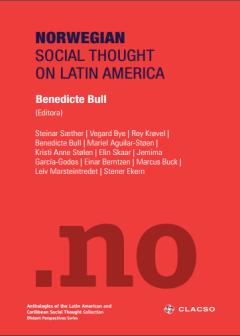
Norwegian social thought on Latin America
Benedicte Bull. [Editora]
Benedicte Bull. Steinar Sæther. Vegard Bye. Roy Krøvel. Mariel Aguilar-Støen. Kristi Anne Stølen. Elin Skaar. Jemima García‐Godos. Einar Berntzen. Marcus Buck. Leiv Marsteintredet. Stener Ekern. [Autores de Capítulo]
....................................................................................
Colección Antologías del Pensamiento Social Latinoamericano y Caribeño.
ISBN 978-987-722-201-2
CLACSO.
Buenos Aires.
Agosto de 2016
*Disponible sólo en versión digital
What motivates social sciences field researchers in the in a small, peripheral and distant country as Norway to study social phenomena in Latin America? To what extent can we say that the Norwegian social thought is part of a hegemonic Western knowledge project? The researchers who by birth or (bad) luck do have Norway as geographic base for their academic work, have really something in common? These are some of the questions that we explored in this book. The purpose is to analyze the Norwegian social thought on Latin America in the context of Norwegian geopolitics — interpreted here as ‘the geopolitics of the weak’ —, the cooperation and development policies, as well as the different international lines of thought in the academic and ideological fields. This book is a fundamental contribution to understand the relationship between these two distant regions, but which cultivate an ever-enriching academic dialogue. |
|
| |
|
|
| |
|
|
|
| |
| |
|
|
|
|
| |
|
| |
|


