| |
|
| |
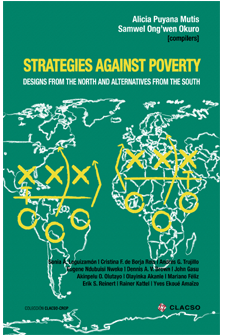
Strategies Against Poverty
Designs from the North and alternatives from the South
Alicia Puyana Mutis. Samwel Ong´wen Okuro. [Editores]
Sonia Álvarez Leguizamón. Cristina Fróes De Borja Reis. Alicia Puyana Mutis. Andrés García Trujillo. Eugene Ndubuisi Nweke. Dennis A.V. Brown. John Gasu. Akinpelu O. Olutayo. Olanyinka Akanle. Samwel Ong´wen Okuro. Mariano Féliz. Erik S. Reinert. Rainer Kattel. Yves Ekoué Amaïzo. [Autores de Capítulo]
....................................................................................
Colección CLACSO-CROP.
ISBN 978-987-1543-63-2
CLACSO.
Buenos Aires.
Junio de 2011
*Disponible sólo en versión digital
This book presents the contributions of African and Latin American experts on economic development to the seminar “Strategies against poverty: Designs from the North and Alternatives from the South” organized by the Conferencia Latinoamericana de Ciencias Sociales, CLACSO, the Comparative Research Programme on Poverty, CROP and the South- South Exchange Programme for Research on the History of development, SEPHIS. The purpose of the seminar was to open space for debate, from a historical perspective, alternative theoretical approaches on the causes of poverty and to explore the, sometimes diverging, strategies to its eradication as proposed by the North, donors and multilateral organizations, and by the South, governments and non-governmental organizations. The particular interest in studying poverty in the context of developing countries, often called the South, is to show the profound socio-economic inequalities existing in these countries and the problems that result when the programs structured to mitigate poverty are, in too many cases, a mere incorporation to local scenarios of the "universal policies, from international and funding agencies. These programs made with the idea that one size fits all, ignore the needs, priorities and realities of individual countries and regions and only meet the North's neoliberal paradigms. There is no need to stress the relevance of comparative analysis of the effects of colonial and neo-colonial powers to understand the factors constraining economic growth in developing countries. The works presented in this volume constitute one step in the direction of finding both, similar problems and akin solutions and to envision policies that respond to local and national history, conditions and priorities. |
|
| |
|
|
| |
|
|
|
| |
| |
|
|
|
|
| |
|
| |
|


