| |
|
| |
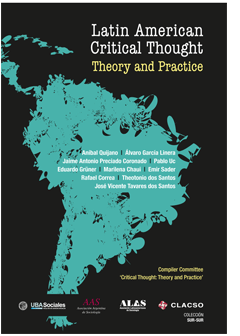
Latin American Critical Thought
Theory and Practice
Alberto L. Bialakowsky. Pablo Gentili. et. al.. [Compiladores]
Aníbal Quijano. Álvaro García Linera. Jaime Antonio Preciado Coronado. Pablo Uc González. Eduardo Grüner. Emir Sader. Rafael Correa. Theotonio Dos Santos. José Vicente Tavares dos Santos. Marilena Chaui. [Autores de Capítulo]
....................................................................................
Sur-Sur.
ISBN 978-987-1891-05-4
CLACSO.
Buenos Aires.
Agosto de 2012
*Disponible sólo en versión digital
The resurgence of Latinn American critical thought in the late 1990s and the early twenty-first century has brought about some discoveries that distinguish it from the sociological production of the world. it is a scientific framework that has taken on the features of a new social scientific paradigm. A growing number of authors have aligned themselves with this perspective, with visions that include critical readings geared to contributing to transformative social change, in a Latin American context. Thus, we ask ourselves: What are the characteristics that distinguish Latin American critical thought and give it its identity? What are its germinal features and what are its unresolved matters? A distinguishing feature of this thought is its belonging to social sciences, particularly sociology and its traditions of critical theory, whose roots, as gramsci said, do not come from fundamentalist opposition but rather from the acquisition of scientific certainty on the basis of critical analysis (...) |
|
| |
|
|
| |
|
|
|
| |
| |
|
|
|
|
| |
|
| |
|


